Wireless bridges: when a 5 GHz link beats digging a trench
Trenching fibre to a single building across a road, a rail line or a river rarely clears its own business case. A 5 GHz bridge does the same job for a fraction of the cost, and the reason people are wary of them is usually a bad experience with an unplanned link rather than anything wrong with the technology.
Two topologies, and they are not interchangeable
Point-to-point (PtP)
One radio at each end, aimed at each other, and the whole capacity of the link belongs to that pair. Use it between two buildings that need a proper connection — a warehouse and an office, a main block and an annexe. Two CPE5 units facing each other is the usual build.
Point-to-multipoint (PtMP)
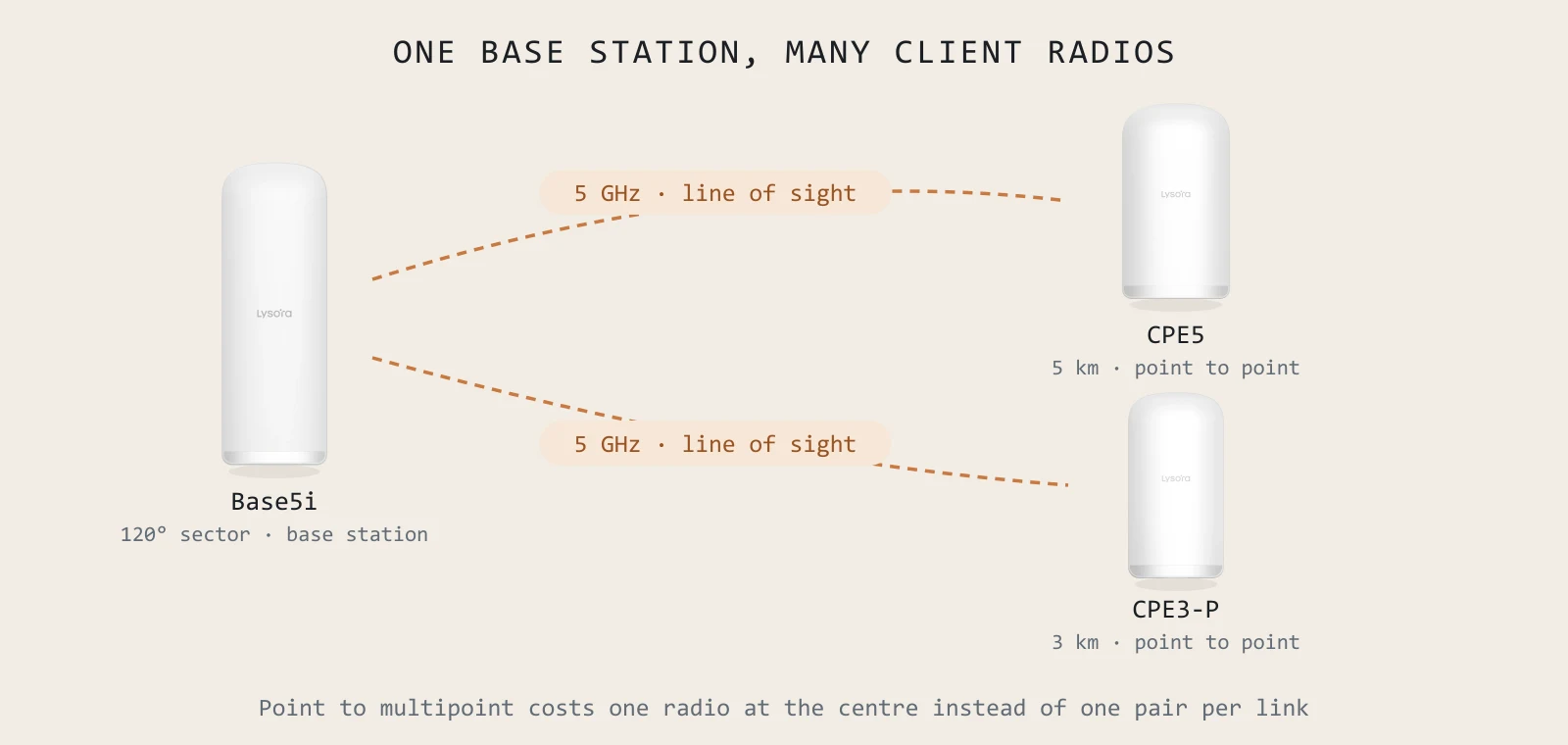
One base station covering a sector, with several CPEs inside it sharing the capacity. Use it when several endpoints sit roughly in the same direction — an ISP serving a cluster of buildings, a campus feeding four outbuildings, a yard with cameras on separate poles.
The Base5i is the base station: a 15 dBi antenna covering 120 degrees horizontally, out to 5 km, supporting up to five CPEs. It can also run as a CPE, so one SKU covers both ends if you prefer to stock one thing.
 Base5iThe hub of a point-to-multipoint link, out to 5 km.
 CPE5The far end of a 5 km link, with the highest gain in the range.
 CPE3-PA 3 km CPE that also powers the camera at the far end.
What antenna gain and beamwidth actually mean
Higher gain is not simply better. Gain comes from focusing the same energy into a narrower cone — a 16 dBi CPE reaches further than a 13 dBi one because it is looking at a smaller slice of the world. That makes aiming more critical and makes the link less forgiving of a mast that moves in the wind.
| Model | Antenna | Range | Role | Ports |
|---|---|---|---|---|
| Base5i | 15 dBi, 120° sector | 5 km | BaseStation or CPE | 3× Gigabit |
| CPE5 | 16 dBi directional | 5 km | CPE, PtMP up to 5 | 3× Gigabit |
| CPE3-P | 13 dBi directional | 3 km | CPE with 15.4 W PoE out | 3× 10/100 |
Why TDMA matters the moment you add a third CPE
Without scheduling, radios on a shared channel contend: they transmit, collide, back off and retry. With two endpoints that is tolerable. With five it degrades badly and unpredictably, and the first link — which worked fine — gets worse every time you add another.
TDMA gives each CPE a scheduled slot instead. Throughput per station drops as you add stations, which is unavoidable, but it drops predictably rather than collapsing. That predictability is what makes a PtMP sector something you can actually sell capacity on.
The survey questions that decide it
- 1Is there clear line of sight? Not roughly — actually. Stand at both ends and look. If you cannot see the other mount point, the link will not perform as rated.
- 2What will grow into the path? Trees are the classic failure: a link commissioned in January through bare branches degrades every summer and eventually for good.
- 3How stable are the mount points? A pole that sways moves a narrow beam off target. Higher gain makes this worse, not better.
- 4What is the distance, honestly measured? Marketing maxima assume ideal conditions. Design at comfortably under the rated range, not at it.
- 5What else is on 5 GHz nearby? Run a spectrum scan — the Base5i and CPE models have one built in — before choosing a channel rather than after complaints.
- 6Is there power and a path for the cable at both ends? The radio is often the easy part.
A typical CCTV backhaul build
Can a wireless bridge really replace fibre?
For a single building at moderate distance, usually yes. These links carry 867 Mbps on 5 GHz, which is ample for cameras, VoIP and general office traffic. Where it does not replace fibre is a link that must carry many gigabits or one with no clear line of sight.
How many CPEs can one Base5i serve?
Up to five, with TDMA keeping throughput predictable as they are added. Capacity is shared, so five CPEs each get roughly a fifth of the sector — plan the per-site requirement against that, not against the headline rate.
What range will I actually get?
The Base5i and CPE5 are rated to 5 km and the CPE3-P to 3 km, in clear line of sight with proper alignment. Design at comfortably under those figures. Send us the two coordinates and we will check the path before anything is quoted.
Do I need a licence for 5 GHz in India?
The 5 GHz bands used for these links are de-licensed in India for low-power outdoor use, subject to the current power and channel rules. Those rules do change, so confirm the applicable limits for your deployment date and location rather than assuming.
Sizing something specific right now?
Send the floor plan, the camera count or an existing BOQ. You get a coverage heatmap and a line-item quote back, free.