Buying Lysora in India: what a dealer should tell you before you order
Search for a Lysora dealer in India and you will find a handful of pages that all look the same: a paragraph about the brand, six or eight model numbers, a list of cities, and a contact form. None of them tell you what you actually need to decide — how many models exist, which one fits your site, and what the brand does and does not publish. This is the page we wish had existed.
What Lysora actually is
Lysora is a networking hardware brand built around a single cloud management plane. Switches, routers, access points and wireless bridges all report into the same console, and that console is not sold as a per-device subscription — which is the main reason the brand comes up at all in a market where Meraki and Aruba Central renewals are a recurring line item for the life of an estate.
The catalogue is deliberately narrow. Four categories, twenty-eight SKUs, and nothing outside them. If a page tells you Lysora makes GPON equipment, SFP modules, media converters or firewalls, that page is wrong — the manufacturer publishes none of those. A narrow range is easier to know properly, which is the whole argument for buying it from someone who has bothered to.
| Category | Models | Range |
|---|---|---|
| Switches | 13 | 4-port desktop PoE up to 48-port aggregation, plus multi-gig, Layer 3 and industrial |
| Cloud Routers | 3 | 600 Mbps branch box up to a 4 Gbps rack unit rated for 1,500 clients |
| Access Points | 9 | Wi-Fi 7 tri-band BE14000 down to Wi-Fi 6 AX1800, indoor, wall-plate and outdoor |
| Wireless Bridges | 3 | 5 GHz point-to-point and point-to-multipoint, links to 5 km |
 LS2-24GT4SFP-PThe workhorse: 24 PoE+ ports, 370 W, four SFP uplinks.
 L7ProThe flagship: tri-band Wi-Fi 7 with a 10G SFP+ uplink.
 LR300G-PGateway and PoE switch in one box, for 300+ users.
 CPE5The far end of a 5 km link, with the highest gain in the range.
Where it sits against the brands you already know
This matters more than a spec sheet, because the honest answer decides whether you should be reading further at all.
Against Cisco and HPE Aruba
The enterprise incumbents win on ecosystem depth and on tenders that name them outright. They lose on total cost when the licence renewal lands. If your tender specifies a named vendor, specify that vendor — we supply those lines too, and saying otherwise would waste everyone's time.
Against Ubiquiti
Both target the same buyer: an integrator who wants cloud management without an enterprise contract. Lysora publishes camera-capacity figures per switch, states a three-year warranty on switches, routers and bridges, and carries NDAA compliance on most of the line. Those three things decide surveillance and government-adjacent projects. Ubiquiti has the larger installed base and the deeper community, which matters when your engineer has already learned one console.
Against TP-Link Omada and the value tier
The gap shows in the specification table rather than the brochure: full 4094-VLAN Layer 2, 400,000-hour MTBF on the managed line, DIN-rail models rated to +75 °C, and Layer 3 OSPF aggregation. For a ten-user office with no VLANs and no cameras, the value tier is the right answer and we will say so.
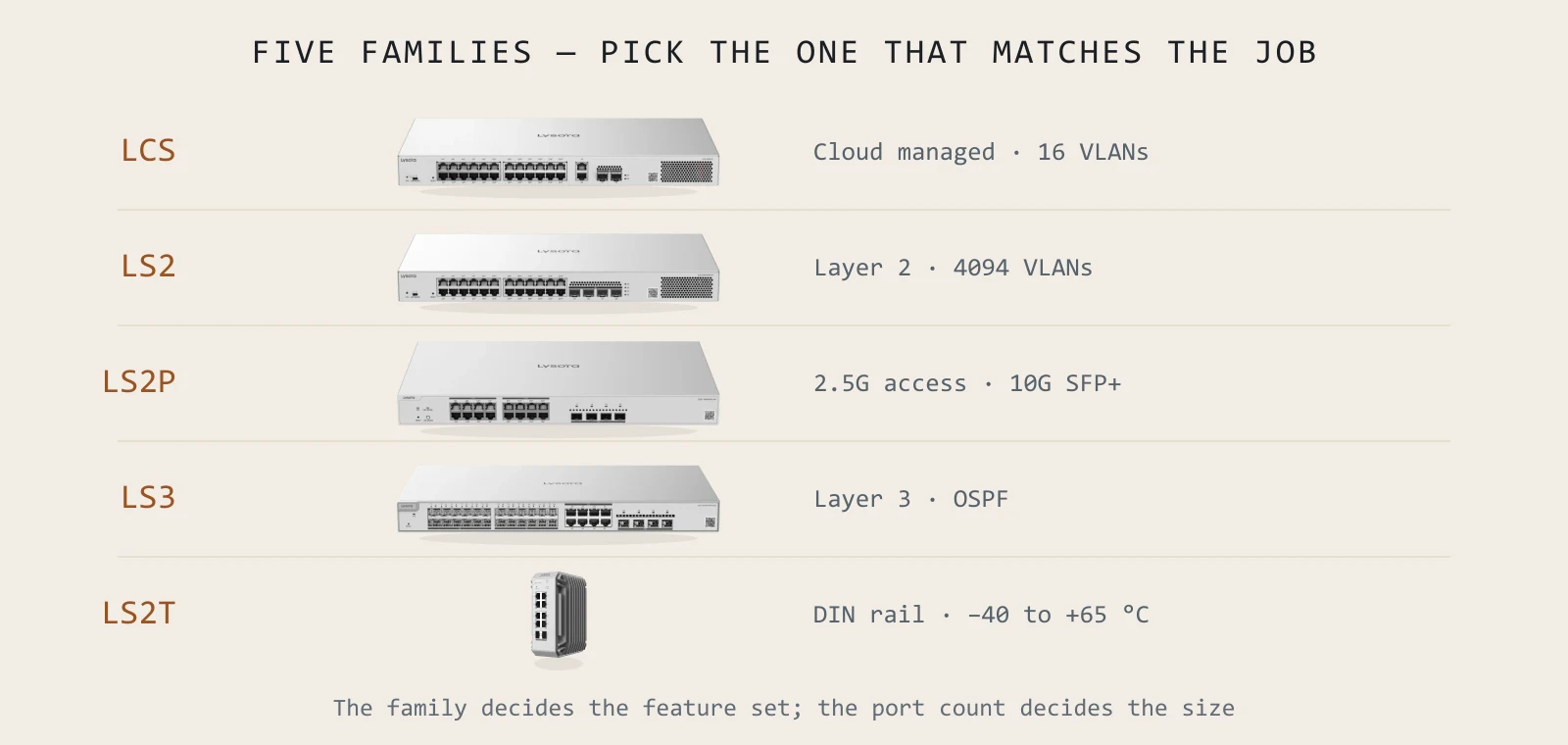
The five switch families, and which one you need
Thirteen switches sounds like a lot until you see that they fall into five families. Pick the family from what the network has to do, then pick the port count from how big it is.
NDAA compliance is per model, not per brand
Eighteen of the twenty-eight SKUs carry NDAA compliance, spread across all four categories. It genuinely varies by model — two switches in the same family can differ — so any page that claims it for the brand as a whole is being careless with something a tender will check. Every product page on this site flags it per SKU exactly as the manufacturer states it, and the catalogue has an NDAA-only filter if it is a hard requirement.
How Lysora pricing works in India
Lysora sells through partners rather than at a published list price, so no honest page can show you a number. Quantity, configuration, category mix and whether the requirement is a one-off or a recurring project all move it materially. Anyone showing you a fixed price for a Lysora SKU is either quoting a single unit at retail or making it up.
What you should get instead is a line-item quote: SKUs, quantities, per-unit price, totals and GST at 18 percent on one sheet you can forward to your own customer without editing it.
Questions worth asking whoever quotes you
- 1What is the PoE budget of this switch, and how many of my actual cameras will it carry at full draw? A supplier who cannot answer this from the model number has not sized anything.
- 2Is this specific model NDAA compliant? Not the brand — the model.
- 3What is the warranty term on this line, in writing? Three years on switches, routers and bridges; access points follow the manufacturer's published policy rather than a stated term.
- 4Is it in stock, or is that a lead time? A delivery date you pass to your customer should come from stock, not from an estimate.
- 5Will it ship pre-configured? Camera VLAN, PoE watchdog, SSIDs — asking costs nothing and saves a commissioning day.
- 6If the tender needs an authorisation letter, can you produce one for this line? Partner tier varies by vendor and by tender; get the answer before you bid, not after.
What we do differently
This site documents all twenty-eight SKUs with the manufacturer's own specification tables, including the places where the vendor's listing card and detail page disagree with each other — and on a few models they do. You should not discover a port-speed or PoE-budget discrepancy during commissioning.
Before any order, send a floor plan and we run it through Lysora Cloud's AI Designer and send back a coverage heatmap, the access point count and placement, the PoE budget for the switches behind them, and a line-item BOQ. That costs nothing and carries no commitment, because a guessed AP count is how wireless projects go wrong.
Are you an authorised Lysora dealer in India?
This site is operated by Lizora Infotech, a New Delhi B2B networking supplier. We supply the Lysora range across India and handle pre-sales sizing, quoting, GST invoicing and warranty co-ordination locally. Partner tier and authorisation letters vary by tender — tell us what the document has to state and we will confirm what we can supply against it.
What is the minimum order?
There is no minimum. A single access point and a forty-store rollout get the same sizing work; the difference is scale, not service level. Project quantities get project pricing.
Do you deliver outside Delhi NCR?
Yes, pan-India from New Delhi, including tier-2 and tier-3 project sites. Bulk and project orders are quoted with a delivery timeline against real stock rather than an indicative lead time.
Can you match a BOQ written for another brand?
Send it across. We will map each line to the nearest Lysora equivalent and say plainly where the match is not exact, rather than quoting something that will not do the job. Where Lysora is the wrong answer for a line, we will tell you that too.
Sizing something specific right now?
Send the floor plan, the camera count or an existing BOQ. You get a coverage heatmap and a line-item quote back, free.